Oral and Maxillofacial Surgery (OMFS) Consultant Workforce in the UK - Review of Current Evidence for the Guidance of Trusts and Integrated Care Boards (ICBs) - Executive Summary
Overall Recommendation
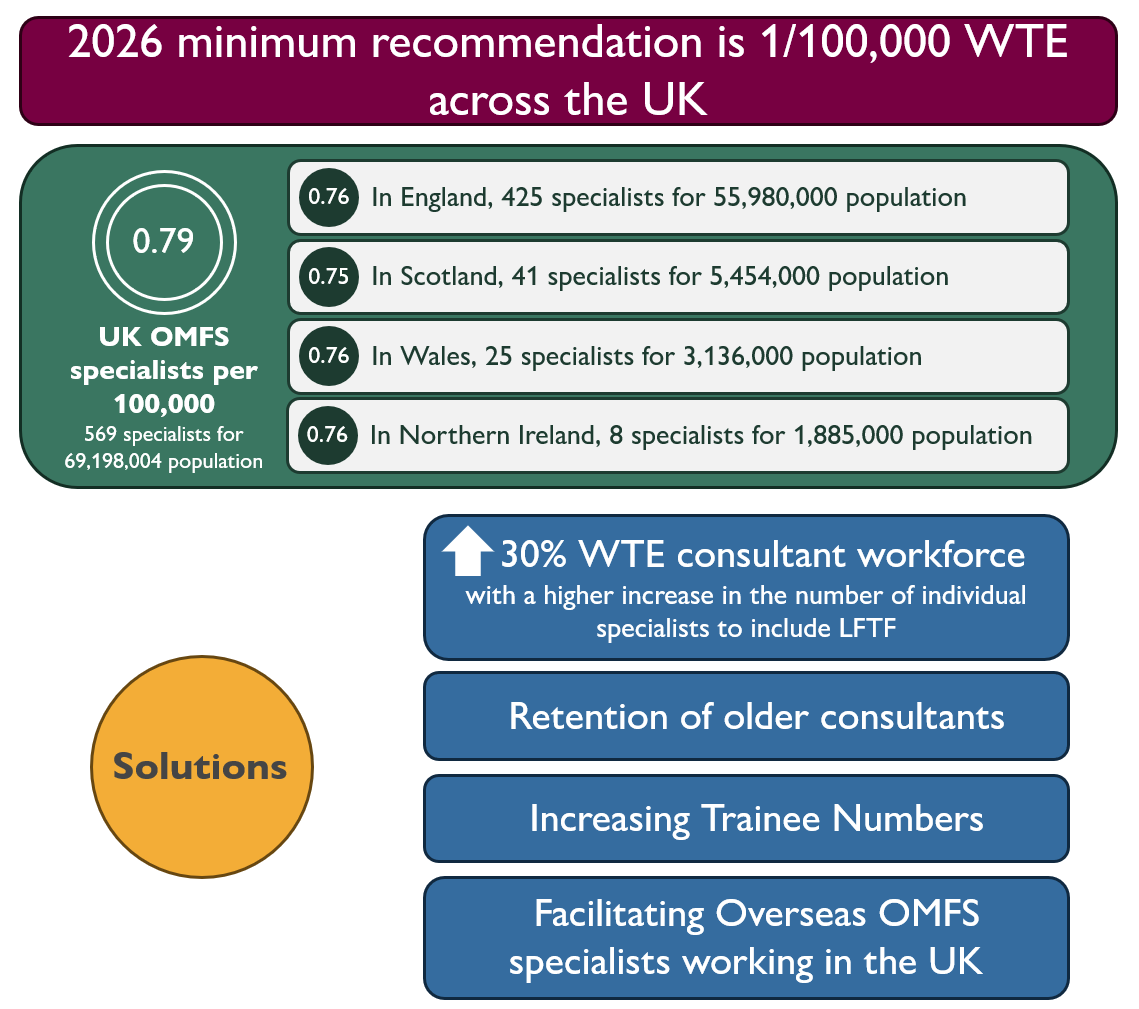
Having reviewed the workforce needs for the specialty of oral and maxillofacial surgery in 2026, the minimum recommendation is 1/100,000 Whole Time Equivalents (WTE) across all the UK with recognition that in Regional Units this ratio should be higher. This minimum recommendation is made by the OMFS specialty association based on contemporaneous workforce data and in the context of GIRFT reports.
We estimate that requires a 30% increase in the Whole Time Equivalent (WTE) consultant workforce with a higher increase in the number of individual specialists (with more consultants working Less Than Full Time LTFT). There are some units which are clearly understaffed highlighted in the OMFS GIRFT Further Faster Report.
Special attention to ensure OMFS Head and Neck Surgery Team Size
The Head and Neck Surgery GIRFT makes recommendations about two consultants operating and 24/7 on-call for microvascular surgery/free-flap which will require an expansion of the workforce in most units.
Avoid the diversion of funds needed for consultant OMFS services to create SAS or Oral Surgery Consultant posts where there are backlogs of dentoalveolar surgery.
Oral Surgery specialists and SAS dentists can only provide a very limited element of OMFS services. Changes in access to NHS Dental Care and the lack of Tier 2 and iMOS services in primary care can place pressures on waiting times and service provision in OMFS who are often the ‘dentist of last resort’ due to their dual qualifications. Trusts and ICBs should be cautious committing resources to address these dental pressures in secondary care by appointing Oral Surgery consultants or SAS grade dentists. When there is appropriate provision in primary care, as is the case in Northern Ireland, surgical dentistry can be delivered in a way that matches the Fit for the Future - 10-year plan at less cost without negative impact on OMFS consultant provision.
For a geographically isolated OMFS unit to achieve the GIRFT recommendation of 6 OMFS consultants in an on-call rota may require sharing on-call with a neighbouring unit or developing a network. Reaching 6 OMFS consultants within a network may also require re-directing patients from specialties which interface with OMFS.
On-call rotas with fewer than 6 make the appointment of consultants challenging. Geographical challenges can make sharing of on-call with neighbouring units or developing an on-call network of at least 6 OMFS consultants difficult.
There are patients who need care which only OMFS can provide. In smaller, geographically isolated OMFS units there may not be sufficient ‘OMFS only care’ across neighbouring Trusts or OMFS networks to support an on-call rota of 6 consultants recommended by OMFS GIRFT.
Trusts in regions with smaller OMFS units should consider how they can work together. This may include a review of care in interface areas including oral surgery, surgical dermatology and plastic surgery which could also be provided by OMFS to ensure that adequate consultant job plans across the patch. This is a strategic priority which requires planning and collaboration.
Additional actions to support OMFS services and training
These include strategies to retain older consultants, increase OMFS trainee numbers, helping develop fully run-through training models (supporting OMFS trainees who are second degree students with Fellow posts), and facilitating OMFS specialists from overseas working in the UK. Retaining consultant surgeons with protected characteristics—such as gender, race, disability, or age—requires addressing systemic barriers in career progression, enhancing work-life balance, and ensuring inclusive environments. The fundamental requirement to address all these issues is an adequate workforce size.
Professor P Magennis, BAOMS President 2025/2026
Mr David JW Keith, Chair of BAOMS Council
On behalf of BAOMS Council April 2026